Residential properties throughout Davidson County regularly face intense seasonal insect pressures caused by the humid subtropical climate of Middle Tennessee. Mosquito and outdoor vector reduction targets biting…
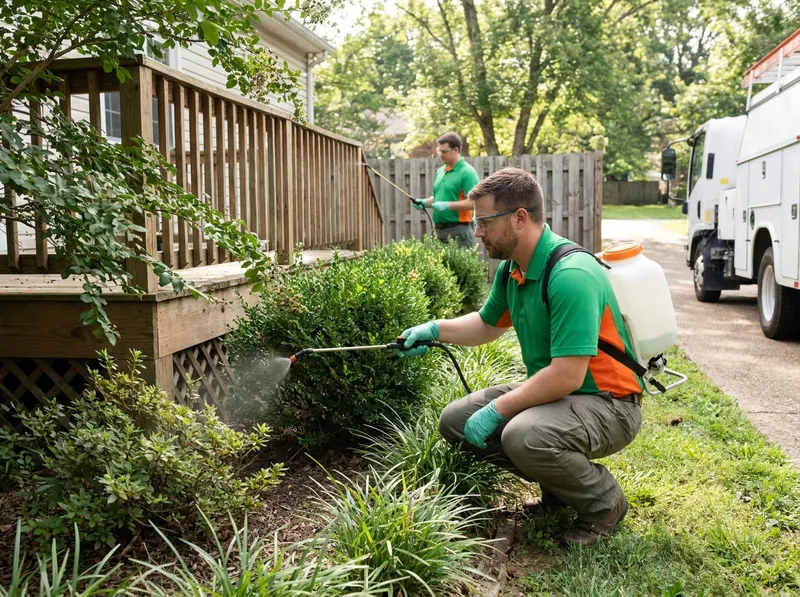
Residential properties throughout Davidson County regularly face intense seasonal insect pressures caused by the humid subtropical climate of Middle Tennessee. Mosquito and outdoor vector reduction targets biting populations where they rest and breed, rather than blanketing entire lawns in blanket chemicals. Dense vegetation in neighborhoods like Belmont-Hillsboro, Green Hills, and Sylvan Park retains deep ambient moisture beneath boxwoods, English ivy, and mature canopy shade. These microclimates allow species like the Asian tiger mosquito to mature rapidly, requiring a balance of biological controls and targeted foliage barriers rather than generic fogging.
Controlling mosquitoes effectively requires treating two distinct biological stages: the aquatic larval phase and the resting adult phase. Standing water collected in drainage catch basins, corrugated downspouts, and low property depressions harbors active larvae. Applying biological larvicides containing Bacillus thuringiensis israelensis prevents aquatic larvae from developing into biting adults without disrupting beneficial aquatic organisms, adhering strictly to EPA pesticide regulations. Resting adult vectors shelter from the afternoon heat on the undersides of broadleaf shrubs, perimeter fencing, and sheltered soffits. Treating these specific micro-habitats with targeted, low-odor pyrethroids bonds residues to plant surfaces, creating an insecticidal barrier that degrades safely under sunlight while avoiding flowering pollinator plants.
Properties bordering natural river systems, greenways, and public parks encounter unique environmental water tables. Homes situated along the Cumberland River basin in Donelson, near the open wetlands of the Shelby Bottoms Greenway in East Nashville and Inglewood, or downslope from Radnor Lake State Natural Area experience constant vector migration from public marshlands. Standard retail yard sprays wash out after a single rainfall event, leaving lawns defenseless within 72 hours. By deploying micro-encapsulated water-resistant solutions aligned with guidance from the Centers for Disease Control and Prevention and the Tennessee Department of Agriculture, our treatments withstand summer thunderstorms along Charlotte Pike in The Nations or the steep drainages of Woodbine and 12 South.
Selecting single-incident vector control over recurring corporate subscription programs gives homeowners financial control based on real seasonal conditions. An event-focused barrier application protects outdoor spaces for family gatherings or seasonal peaks, whereas standard full-season maintenance involves treatments spaced roughly 21 to 28 days apart between April and October. Homeowners seeking reliable vector mitigation without chemical drift can implement cultural moisture management verified by the University of Kentucky Entomology Department, install screened downspout filters compliant with ASTM International drainage specifications, and reference structural barrier guidelines maintained by the National Pest Management Association. To schedule a property inspection or discuss tailored outdoor barrier defense, call PineRidge Pest Patrol at (615) 537-0364.
Every job gets a firm, written price after a free on-site visit.
For standards, safe disposal, and service guidance on pest control services in Nashville, TN, useful references include U.S. EPA, ENERGY STAR, U.S. Dept. of Energy, Consumer.gov, U.S. Census Bureau, and Google Maps. General consumer and small-business resources are available from USA.gov, Better Business Bureau, FTC Consumer Advice, U.S. Small Business Administration, and Ready.gov.
Tell us about your mosquito and outdoor vector reduction job in Nashville and we'll send a clear, written quote, usually the same day.
 PineRidge Pest Patrol